
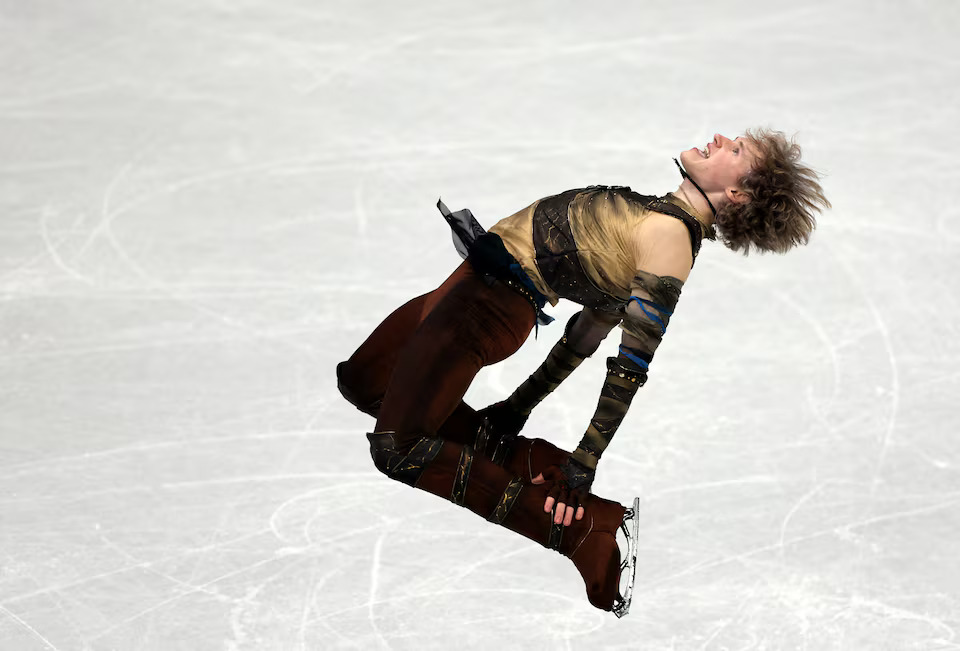
At the 2026 Winter Olympics, Ilia Malinin received a first place score of 200.03 in the men’s free skate on February 8th, further helping Team USA win gold in the team figure skating event. Malinin’s score was based on his routine’s composition and technical difficulty. While not awarded any technical points, his backflip on ice received mixed attention from crowds and the media for being the first time the skill was performed at the event since it was unbanned in 2024.
“I was impressed when I saw it. It was done really well,” Addison Gregg (11) said.“The ban was lifted in 2024 but it doesn’t give much points so it’s like a high risk low reward situation.”
The backflip was first banned in 1976 by the International Skating Union for being unsafe shortly after Terry Kubicka became the first person to perform it at the Montreal Winter Olympics one year prior. 20 years later at the 1998 Olympic Games, France’s Surya Bonaly performed the same move knowing it was outlawed, landing on one blade. Although Bonaly felt pressure as a black woman competing alongside predominantly white athletes, her primary focus was showcasing her capabilities.
“I didn’t want it to be that I didn’t win because people are racist or people don’t like me. If I didn’t win or finish at the top, I probably didn’t do enough. My only goal was I need to do more than anyone else,” Bonaly said in an interview with the Today Show.
Known as a pioneer in her field, Bonaly is a five time European champion, three-time Worlds silver medalist, and nine-time French National champion. Bonaly was ultimately penalized for the backflip and placed 10th, leading to the end of her Olympic career. As such, people now question why Malinin garnered more positive attention from the same feat.
“I believe [Bonaly] was treated fairly unfairly. She got some major criticism for demonstrating a skill that she had also done really well,” Gregg said. “I feel they should’ve at least gotten some equal backlash or [Malinin] even get more considering I think he did it more than once.”
While many make the media’s reaction out to be due to the difference between Malinin and Bonaly’s race or gender, acceptance of creative expression and the competitive legalities of the backflip is shown to have influenced perceptions of different generations.
“I really like being able to stand out from a crowd, and to do things my own way,” Malinin said in an interview with NBC. “I love that you can express [figure skating] any way that you like, and you can really dig deep into your personality.”
The history of the backflip in figure skating spans over around 50 years. The experiences of Bonaly and 21-year-old Malinin highlight the shift between traditional and modernity in terms of the performer’s liberty. Both are applauded for their ability to push boundaries of what is thought to be humanly possible, and although controversial, Malinin’s backflip carries a legacy of Bonaly’s influence.